



Utah Department of Transportation
Connecting the West (CTW)
In Fall 2024, the United States Department of Transportation (USDOT) awarded cooperative agreements collectively worth $60 million to Maricopa County DOT (MCDOT), Texas A&M Transportation Institute (TTI), and Utah DOT (UDOT) to deploy, operate, and showcase secure, interoperable vehicle-to-everything (V2X) deployments.
Problem
An unacceptable number of crashes and fatalities occur at intersections, in work zones, along rural corridors, and during bad weather. Increasingly, these crashes impact pedestrians, cyclists, and other road users. Such incidents, work zones and weather also result in frequent delays on interstate and rural corridors that impact the traveling public. Similarly, snowplows experience delays in the winter, resulting in slower clearance times and increased operational costs. Additionally, downtown transit vehicles regularly experience delays that impact route performance, rider mobility, and transit agency operations costs. With several major corridors that have significant commercial freight traffic, commercial truck drivers often lack information about road closures and weather conditions, which causes uncertainty in their travel planning and impacts their delivery deadlines.
Approach
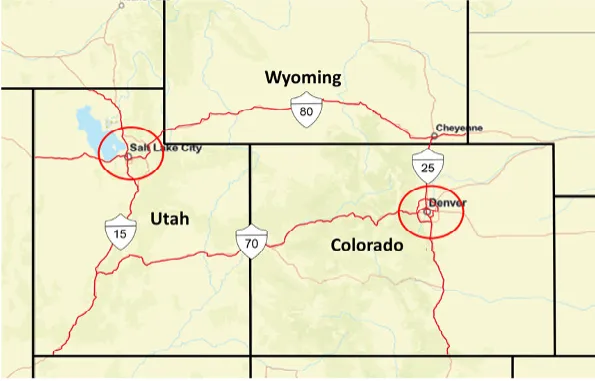
UDOT is leading the Connecting the West (CTW) project that aims to transform how people and vehicles move across Utah, Colorado, and Wyoming through the deployment of V2X technologies in the 5.9GHz "safety spectrum" that enable real-time communication between vehicles and surrounding infrastructure. These tools provide the capacity for alerting drivers about potential hazards - weather, work zones, disabled vehicles - and increasing awareness at critical moments, ultimately supporting the overarching goal of zero roadway fatalities. This deployment will leverage significant deployments that already exist in all three states, including equipped freight, transit and maintenance vehicles. Additionally, the program will deploy 770 roadside units (RSU) at intersections and along key corridors in Utah and Colorado, as well as 220 additional onboard units (OBU) in fleet vehicles, snowplows, transit buses, and emergency vehicles -enhancing their ability to get priority at intersections and get to their destination faster.
V2X Applications & Benefits
- Real-time hazard alerts for weather, work zones, and disabled vehicles
- Enhanced intersection visibility and priority for fleet vehicles
- Improved safety for pedestrians, cyclists, and road users
- Priority routing for transit, emergency, and maintenance vehicles
- Commercial freight information and travel planning support
Partners
In addition to the UDOT team, Connecting the West brings together the Colorado and Wyoming Departments of Transportation, the Utah Transit Authority, Salt Lake City, the City and County of Denver, General Motors, and key federal and private-sector partners. This collaboration ensures the systems built are interoperable across state lines, scalable for future needs, and are reflective of a safer and smarter transportation ecosystem as a whole.

Value Proposition
The impact of Connecting the West reaches far beyond individual corridors or intersections. By proactively addressing roadway risks and empowering transportation agencies with real-time data, the program strengthens the safety net for all travelers. Long-term implementation of this technology offers a wide range of benefits and supports key goals, including:
- Enhanced safety through real-time hazard alerts and intersection visibility
- Improved mobility for freight, public transit, emergency responders, snowplows, and everyday drivers
- Encouragement of agency collaboration and transportation infrastructure advancement
- Moving the region closer to the ultimate goal of zero roadway fatalities
- Establishment of a scalable model for nationwide V2X deployment
Links and Resources
Visit the CTW Project Website.
View the Project Documentation